USC professor asked Jeffrey Epstein for money years after guilty plea
Antonio Damasio said he was unaware of Epstein’s sex crimes and wouldn't have met had he known. Epstein declined to fund him.

Tomo Chien
February 02, 2026

(Fronteiras do Pensamento | Flickr)
Antonio Damasio had a problem. It was 2013, and the star USC neuroscientist was closing in on new insights into the origins of human emotions. He needed money for the research, but didn’t want a federal grant — which he feared would mean ceding control of his ideas.
So Damasio turned to a private benefactor: Jeffrey Epstein, the disgraced New York financier, who five years prior had pleaded guilty to soliciting prostitution after he paid underage girls to give him sexual massages in his Florida mansion.
Damasio, who leads USC’s Brain and Creativity Institute, approached Epstein nonetheless. In February 2013, after a brief exchange by email, the two men were scheduled to meet in Epstein’s Manhattan townhouse to discuss Damasio’s research, according to new documents released by the U.S. Department of Justice.
In an interview, Damasio said he never received money from Epstein and was unaware of his guilty plea. Epstein was not then the household name that he has become, but his charges were covered by the national media and the legal battle over federal prosecutors’ handling of the case would continue for the next decade.
“I did not know at all,” Damasio said. “Or I would not have talked to him.”
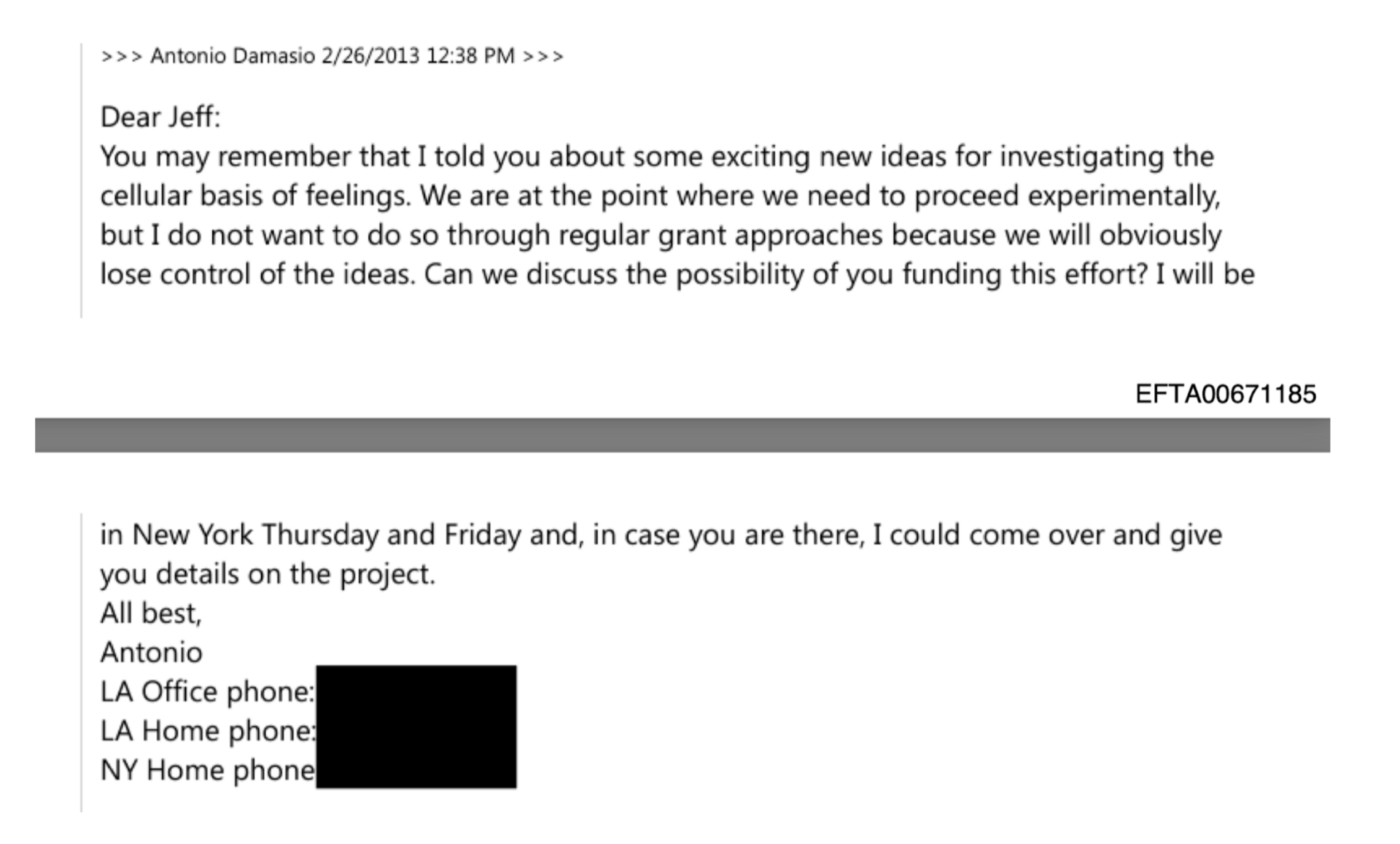
Damasio said he did not maintain a relationship with Epstein or visit the multimillionaire’s infamous island. Countless people are named in the 3 million pages of documents released by the Trump administration, and appearing in the files does not mean that somebody was complicit in sex crimes.
Damasio said he first learned of Epstein’s crimes around the time that the financier killed himself in a federal detention center in 2019.
“Everybody here knows about my episode with Epstein: everybody in the lab, all my friends,” Damasio said. “The thing that I always say is how lucky I was that he did not want to fund me.”
Epstein’s ties to the scientific community are well-known. He spent millions funding research by world-class scientists and maintained close friendships with many of his beneficiaries. “As some collect butterflies, he collects beautiful minds,” a 2002 New York Magazine profile said of Epstein.
But unlike Harvard and MIT, which have been rocked by revelations of deep faculty ties to Epstein, no connections between USC professors and Epstein have been reported until now.
Damasio was on Epstein’s radar as early as 2009. In April of that year, Epstein was looking to host a gathering of “smart, out-of-the-box types” in Florida, and asked the late computer scientist Roger Schank for potential guests. Schank responded with a list of university professors that included Damasio, whose name would continue to appear in emails discussing a potential gathering throughout the year.
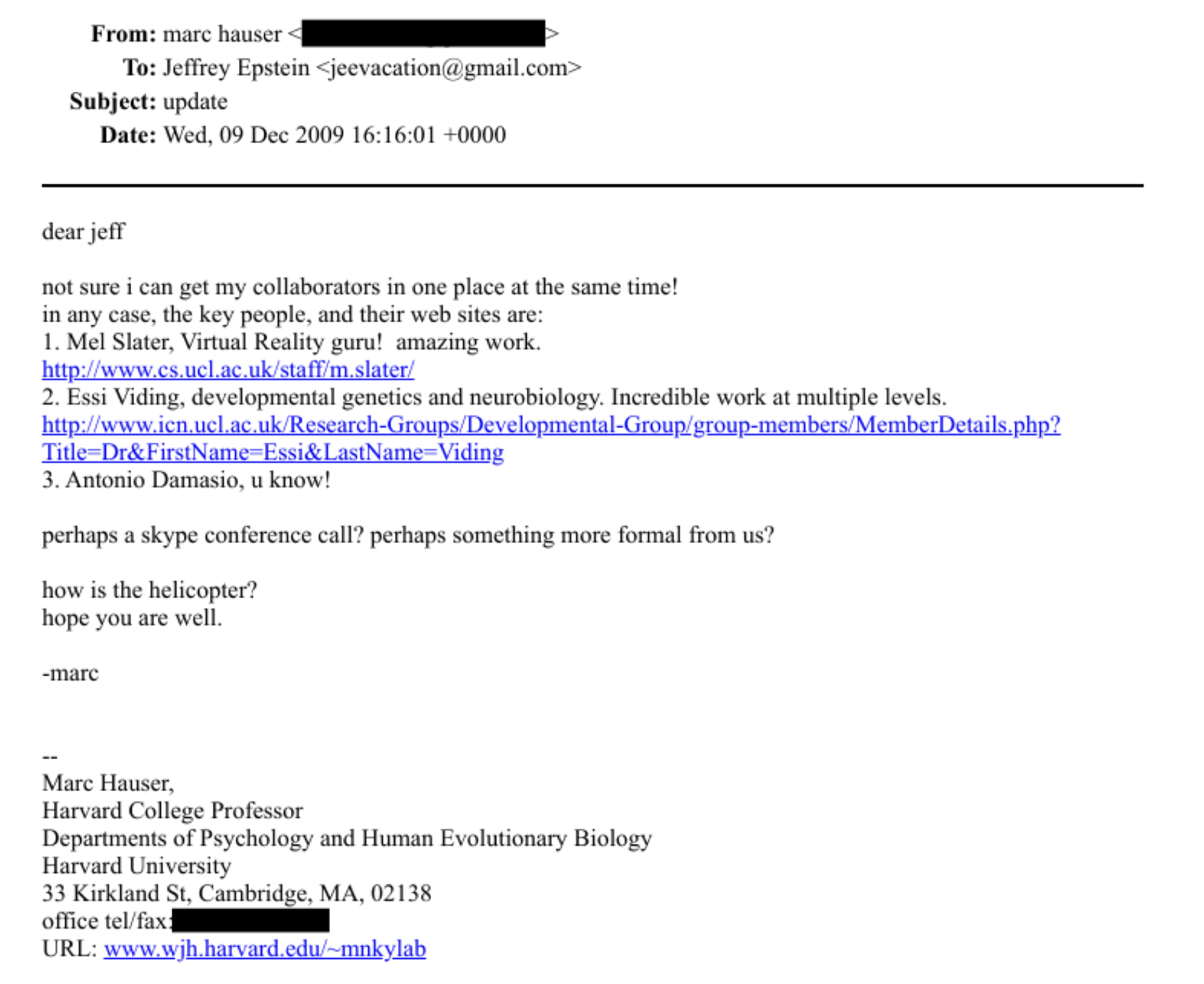
Damasio said he never attended a Florida gathering, but that at some point before their 2013 New York City meeting, he and his wife — who is also a prominent USC scientist — attended a dinner hosted by Epstein. Damasio could not recall details of the dinner.
Four years later after his name first appeared in Epstein’s inbox, Damasio needed to raise money for his project. Several colleagues suggested that he contact Epstein, a known patron of the sciences, Damasio said. It is common for academics to seek funding from private philanthropists.
His calls and emails went unanswered, so he turned to Richard Wurman, the co-founder of TED conferences — could Wurman please share Epstein’s contact information? Wurman obliged, and within several hours Damasio was scheduled to meet with Epstein for an hour in his Upper East Side townhouse.
“I was interested in having funding,” Damasio said. “It was also quite obvious that he was interested in having me in his circle of scientists.”
Still, Damasio said Epstein ultimately declined to provide funding.
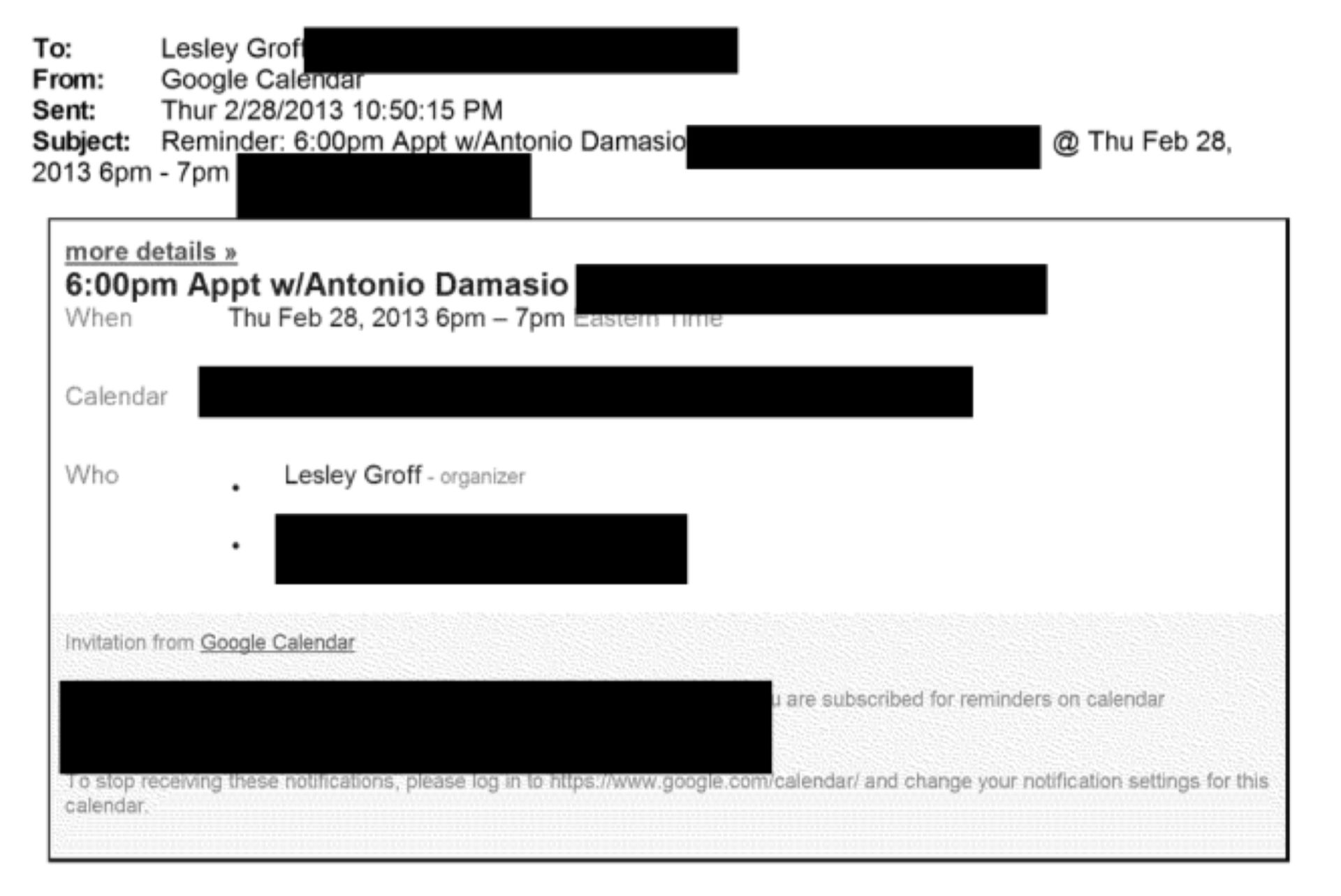
Lesley Groff was Epstein’s longtime assistant.
“This is your chance to get an A,” Damasio emailed Epstein after the meeting. “Not only that, the robots that you so like need to import equivalent machinery in order to be worth their trouble.”
It is unclear what Damasio was referring to, and the email was the last evidence of direct communication between him and Epstein in documents released by the Department of Justice thus far.
Years later, though, Damasio appeared in a 2019 PBS science series, “Closer to Truth,” which was funded by Epstein. Damasio could not recall the specific TV series — he gives many interviews, he said.
Several months before his death in a federal detention center, emails show that Epstein touted the show’s all-star lineup of scientists to a contact.
“just a piece of what i am up to,” Epstein wrote to a redacted email address, with the lineup of scientists attached.
“Whoa amazing list of thinkers!” the person responded.
Correction: A previous version of this story incorrectly stated that Damasio is the chair of USC’s neuroscience department. Rather, he leads the school’s Brain and Creativity Institute, and holds an endowed position referred to as the David Dornsife Chair in Neuroscience.
Tomo Chien can be reached at tomo@morningtrojan.com.